
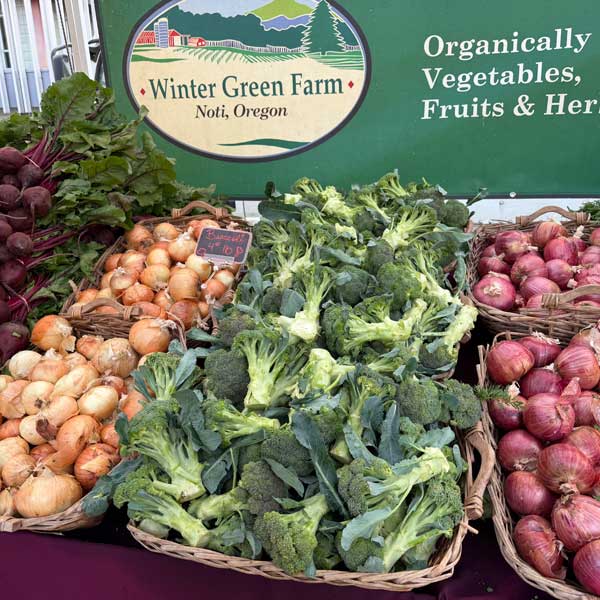
My husband and I recently traveled to Washington and Oregon to visit our grandchildren and their families. After enjoying several days in Seattle, we drove south down the highway, through the city of Portland, and then onto Eugene, Oregon. The highway took us past of leafy fields of high bush blueberries and stately rows and rows of compact trees of hazelnuts.
In addition to its diverse landscapes, Oregon is noted for its commitment to environmental consciousness and sustainability. The state also ranks fifth in vegetable production in the United States. This was abundantly clear on a trip to the Lane County farmer’s market in Eugene on Saturday, where over 100 farms and food artisan vendors promoted their wares. Stalls of brightly colored red, purple, yellow and green peppers, luscious raspberries, strawberries and high-bush blueberries, new potatoes, apples, freshly baked breads and pastries, local meats and cheeses, multitudes of melon varieties, heirloom tomatoes, cucumbers of every size and shape, purple, white and green brassicas, hazelnuts, fresh herbs and so much more.
I must confess, as a foodie I was overwhelmed, and wanted to add everything to my shopping basket. As my mission was to prepare a salad for our Sunday picnic, my selections included a head of bright green broccoli, golden red Gala apples, roasted hazelnuts and a purple onion.
 Broccoli is an important crop both in Oregon and in Maine. Essentially a large edible flower, broccoli, botanically known as Brassica oleracea italica, is native to the Mediterranean. It was engineered from a wild cabbage by the Etruscans, an ancient Italian civilization often considered horticultural geniuses, who also developed other brassicas including cauliflower, kale and Brussel sprouts. Its English name, broccoli, is derived from the Italian word broccolo, which means “the flowering crest of a cabbage”.
Long considered a very valuable food by the Italians since the Roman Empire, broccoli was first introduced in England in the mid-18th century and was referred to as “Italian asparagus.” Food historians note that the avid gardener and president Thomas Jefferson experimented with broccoli seeds brought over from Italy in the late 1700s. A nutritional powerhouse, broccoli did not become a popular foodstuff in the United States until Southern Italian immigrants brought it over in the early 1920s.
The recipe for Broccoli and Apple Salad is from my archives. A tasty and creative way to eat more fruits and veggies, I love the texture and flavors of this salad; crisp, crunchy, sweet, dense, and chewy. The combination of onion and maple syrup highlight the natural sweetness, and the toasted nuts or sunflowers seeds provide a finishing touch. Simple to prepare, and delicious to eat, this salad travels well to a picnic, is perfect to pack in the lunchbox, and appeals to all ages.
 Because broccoli is a cool weather crop, it is perfectly suited for cultivation here in Maine. Available fresh at your local market or farm stand from late July until the end of October, large scale broccoli production is done by Smith Farms in Mars Hill, a fifth-generation farm that first introduced broccoli in the 1950’s. Fall also marks the beginning of apple harvest, another important local crop. Maine is home to more than 100 apple varieties, and pick-your-own apples, tangy apple cider, and fresh apples are widely accessible throughout the state.
Euell Gibbons, author of the 1962 classic “Stalking the Wild Asparagus” helped to inspire the back-to-nature, natural food and environmental movement. Celebrating and connecting with nature, supporting sustainable and local agricultural, and enjoying local, Maine foods both excites our palates and nourishes our soul.

Apple and Broccoli Salad
Ingredients
- 1 head broccoli chopped into bite-sized pieces, about 2 cups
- 1/2 cup dried fruit raisins, cranberries, apricots, cherries
- 1 apple cored and cut into bite-sized chunks, about 1-cup
- 1 tablespoon lemon juice
- ¼ cup chopped red onion
- ¼ cup chopped toasted nuts hazelnuts, pecans or walnuts or lightly toasted sunflower seeds
For the Dressing
- 3 tablespoons mayonnaise
- 1- tablespoon apple cider vinegar
- 1- tablespoon Maine maple syrup
- Maine sea salt and fresh pepper to taste
Instructions
- Assemble ingredients and tools.

- Core the apple and cut it into bite-sized chunks.

- Add the apples to a bowl and toss with the lemon juice.

- Wash and chop the broccoli. Add the chopped broccoli to the bowl. Toss gently.

- Chop the red onion and add it to the bowl.

- Add the dried fruit and chopped nuts or toasted seeds to the bowl.

- To prepare the dressing, in a small bowl, whisk together the mayonnaise and apple cider vinegar until smooth. Whisk in the maple syrup.

- Add the dressing to the salad ingredients and stir well to coat. Allow the salad to chill for at least 30 minutes or more for the flavors to marry. Before serving, season the salad to taste with Maine sea salt and fresh pepper.
